
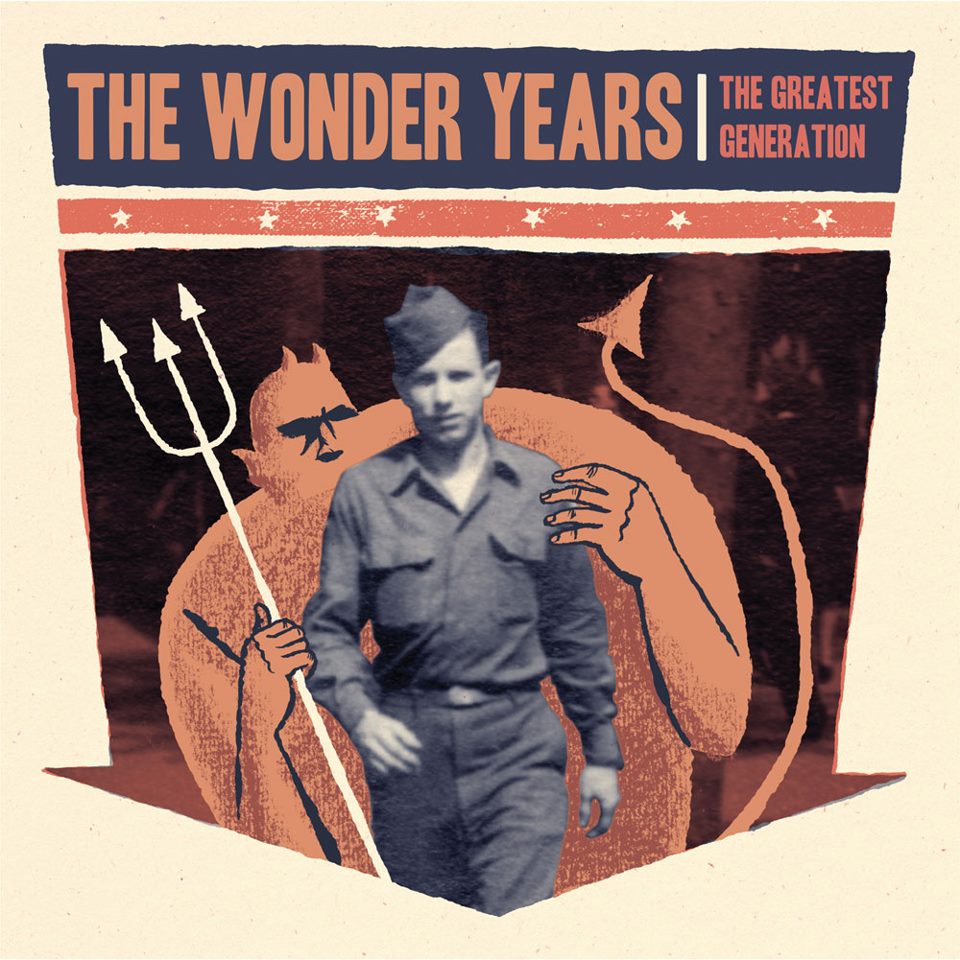
 Almost a year ago, I wanted to write a review for The Greatest Generation. I got out my notebook immediately after my first listen—I wanted to write a few first impressions. But I just stared at the page.
It was past midnight already, and half of my dorm room was packed up in boxes. The other half was cleared out completely, my roommate had left for the summer a few days back. A surgical plastic-covered mattress graced a wooden skeleton bed frame, looking especially thin without the boxes and belongings that had been shoved beneath it for the preceding nine months. I unclicked my pen, hopped off my bed over boxes and bins full of books and CDs and crates full of records to my emptied and barren desk.
I unwittingly put the pen in the empty drawer. I hopped back to my bed, put on my headphones, and clicked play for the second time.
You’re just trying to read, but I’m always standing in your light. You’re just trying to sleep, but I always wake you up to apologize. I’m sorry I don’t laugh at the right times.
Still nothing came from brain to pen to page. I listened again, and again, and again, deep into the night. I looked outside my window at the Tampa skyline—lights yellowed and jarring against the black sky. My dad would be here in mere hours to help me move out.
In all honesty, it hadn’t been a good year. Moving away from home and starting “real life” seemed like everything I had ever wished for when I was a senior in high school—but my freshman year left me struggling for solid ground. It just felt like two semesters of me unable to find any sort of confidence in myself. After years of wanting to be on my own and out in the world, it felt really defeating to be so happy to go home after only a year away.
I’m not going to pretend that The Greatest Generation magically fixed all of that. But as I drove down I-4 on a blistering late-spring morning, all of my shit in my dad’s trunk a few yards ahead of me, it sure as hell struck a note.
The highway won, I’m listening to traffic reports one on one, coming quietly undone.
The Greatest Generation is just the kind of album I like. It’s thematically cohesive, and well aware of it. The Greatest Generation reads like Kerouac to punk music—a novel of stream-of-consciousness stories of young Americans wandering the country trying to figure out why the fuck they’re there. It unabashedly takes the “pop-punk” label and runs with it—the thirteen songs of The Wonder Years’ current magnum opus are, for the most part, punchy, chorus-driven, and unrelentingly catchy. They draw comparisons to Motion City Soundtrack, Through Being Cool-era Saves The Day, and Where You Want To Be-era Taking Back Sunday. Yeah, all of it has been done before. And don’t be mistaken; there were probably better albums released in 2013. But none of them meant more to me than this one (although, as time goes on, Trouble Will Find Me has started to get pretty close).
This is so true that, during the first few months of my relationship with The Greatest Generation, I found myself unable to articulate exactly how I felt about it. I knew that it pretty much went without saying that this was the band’s best work, but I really couldn’t bring myself to write much of anything about it as it blasted from my car speakers over the course of the summer and rumbled through the walls of my dorm building after I returned to school.
I went to see The Wonder Years play a couple weeks ago. The band’s live show has always had this kind of stirring effect on me—and after five or six shows attended over the course of four years, it still does. I went with the intention of taking it easy and watching the chaos from the back, but before Fireworks even started playing I was in the second row.
The band played a hefty sum of tunes from Generation, grounded in the overwhelming finale of “I Just Want To Sell Out My Funeral.” I couldn’t help but think about that first listen I had in my boxed-up room, with the city glowing outside my window. And as “Funeral” rang out, I knew that I had left a lot unsaid about Generation, and I was ready to pick up my pen again.
They’re all just fucking excuses.
The narrator of Generation is lost within his ambition. He wants to “sell out [his] funeral;” he rushes toward some inconceivable movie script ending (“I’ll watch as the screen glows”) just for the sake of knowing that he’s not wasted his time. The problem is, these kinds of endings don’t exist in the real world, (“there’s no triumph waiting, there’s sunset to ride off in”) and that’s terrifying.
Throughout Generation, the narrator tries to cope with the idea of lost cinematic finality, the inevitability of a resonant ending as opposed to an explosive triumph. His chief method here is self-justification—it’s okay if he doesn’t succeed in the end because he’s “awkward and nervous,” or because “all we had were hand-me-downs” or because his family has a history of depression. And instead of focusing on defeating these little devils in his life, he just watches them take over, pretending that he’s continuing to fight while complacently telling himself that he’ll eventually give up (“I bet I’ll be a fucking coward, I bet I’d never have the guts for war”). So he’ll stay put, it’s okay, he’ll “die in the suburbs” and that’ll be good enough because everyone always knew he’d never be anything anyway (“I heard the voices, the implications, telling me who I could never be”).
The final song brings this realization to the forefront, and reprises major moments from previous tracks as a means of framing one of the major themes of the album as a whole. “I Just Want To Sell Out My Funeral” is, musically, a gigantic, explosive climactic ending. But the album’s ending is distinctly resonant from a lyrical standpoint. The narrator doesn’t win at the end, doesn’t defeat a dragon or live happily ever after. Instead, he accepts that there is no beginning and ending to his story, because his life exists outside of any story-telling framework. That is, he’s not the main character in a novel or a movie or a record—he’s more than that. He will never win because he will always be a “contender;” because every small success in his life will always be accompanied by another fight, another falling bomb, another “devil on a rocking chair on [his] front porch.”
The Greatest Generation is about evolution. Over the past few years, certain publications and people have taken it upon themselves to deem the latest generation of young adults unproductive, entitled, lazy…you name it. We’ve all been beaten down for one reason or another because of the time we were born and how that classifies us. My friends and I are selfie-taking, Tumblr addicted, iPhone obsessed Facebook fiends who will never do anything good because of when we were born and how we grew up. This rings in our ears as we work toward something greater, and makes it too easy to feel like there’s nothing we can do to move past this perception of us. Whether we cure cancer someday or make it back to the moon or write the next great American novel or whatever, it will never be enough. But these detractors, cynics, and (perhaps true) failings and faults are distractions. We have to take these things in stride if we’re ever going to get anywhere—feel defeated for a moment and evolve to overcome them, personally and as a whole. We have to build on our histories, but never dwell. We may not be the greatest, but we can fight until we die trying.
In the end, the narrator realizes that his endgame, if there could ever be one, is this: “I just want to know that I did all I could with what I was given.” In the end, all that matters is that he never stops being “happy to be a contender.” It’s important to enjoy our small victories when they’re in front of us, and to lament our failures when they’re fresh. But all of this builds into new versions of ourselves. Soon, a year passes and that person in his empty room, defeated and drained, is nearly unrecognizable.
I’m a chaser, but I found stronger winds.
My dad will be helping me move again in a few days, and everything I’ll be leaving behind is a lot different. A group of friends I never thought I’d make, a job doing something I love, and professors who are helping me move forward. Through my school’s honors program, I’m getting the opportunity to study at Oxford University next semester, so I won’t be returning to all of this for eight months. I’ve got to say that I’m terrified that they’ve chosen the wrong person, that I’m not good enough, organized enough, confident enough to do anything of value over there. I’m terrified that I’ll come back and feel alienated from all of the people I’ve grown to care about here.
But these are things I tell myself in order to justify the possibility of future defeat. And, like the narrator of Generation, I’ve come to understand that this is unproductive. I have to take a deep breath, and take everything as it comes—accept the opportunities I have in front of me and do the best I can with them, beyond all reservation. I’ll have to fight everyone around me and myself forever if I ever want to do anything. And so, I’ll leave this place and come back, and eventually I’ll be gone for good. These are the only definites I have, and it’s up to me to fill in the in-betweens and beyond with everything from failure to triumph.
The Greatest Generation did not instigate this change (which is much more subtle than this piece may imply), that’d be too easy. Rather, the album changed alongside me. The 26-year-old narrator of the album is older and wiser than I, has gone through much more. A year ago, I understood much less about these 13 songs than I thought (as I hope is true another year from now). As I found my place here, I began to sing along to the album more confidently and assuredly. And it wasn’t because I had heard the songs 100 times—hell, they’re so catchy I think I knew them all within two weeks of having the album. It was because my realizations and growth over the past year have paralleled the progression of the album. The narrator in “Funeral” is every bit as flawed as he is in the other 12 songs on the record. But here he begins to understand how to better himself, what to focus on and what to leave behind. I’m still technically six years behind him—but I think I’m starting to get it. A lot happened this year, and a whole lot more is going to happen next year. And while I evolve, (hopefully for the better) I’ll have The Greatest Generation to shout along to, louder and louder with every spin.

 Jordan Walsh